

You hear the word “bunk” at summer camp, in a history debate, and in a British classroom. Each time it means something different. That is what makes it confusing.
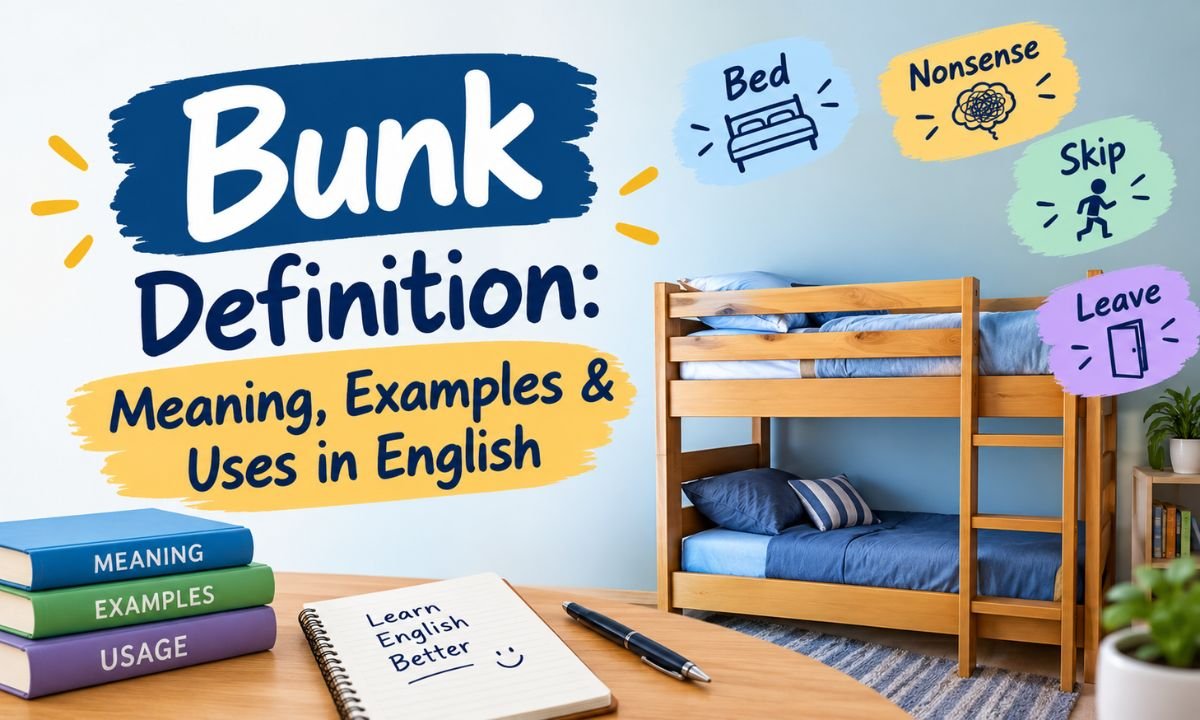
So what is the bunk definition? In short, bunk can mean a narrow bed, nonsense, or the act of leaving or skipping something. This guide explains each meaning, shows real-life examples, and helps you use the word with confidence.
What Does Bunk Mean?
Bunk is a short English word with several unrelated meanings. The most common ones are:
- A bed, usually a narrow one built into a wall or stacked above another.
- Nonsense, meaning false or silly talk.
- To sleep somewhere, often in a shared or temporary spot.
- To skip or leave, mostly in British English.
The right meaning depends on the sentence around it. If someone says “top bunk,” think bed. If they say “that’s bunk,” think nonsense.
Read More: LMS Meaning in Texting: What Does LMS Mean in Text?
Bunk Definition in English
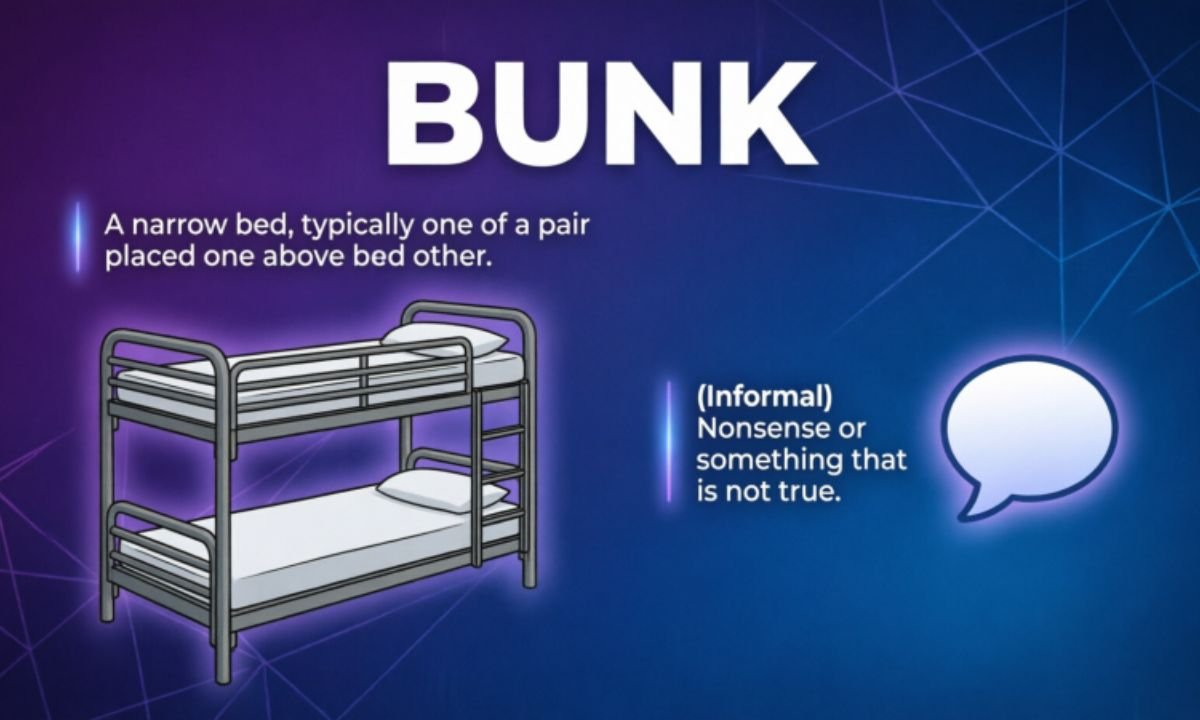
Dictionaries list bunk as both a noun and a verb.
As a noun, bunk means a built-in bed, like the berths on a ship or train. It also means empty or false talk.
As a verb, bunk means to sleep in a bunk or to stay somewhere for the night. In British slang, it can also mean to skip school or work, or to run away.
Here is a quick overview:
| Part of Speech | Meaning | Example |
|---|---|---|
| Noun | A narrow bed, often stacked | She chose the top bunk. |
| Noun | Nonsense or rubbish | The rumor was pure bunk. |
| Verb | To sleep or stay over | You can bunk on our couch. |
| Verb (UK slang) | To skip or leave | They bunked off class. |
Different Meanings of Bunk
Let’s look at each meaning one by one.
Bunk as a Bed
This is the oldest and most literal sense. A bunk is a simple bed, often built into the wall of a ship, train, cabin, or barracks. Beds are frequently stacked in tiers to save space.
You will find bunks in:
- Ships and submarines
- Military barracks
- Summer camps
- Hostels and dorms
- Long-haul trucks
- Overnight trains
People also use “bunk” for any basic sleeping spot. A cabin full of children might have six bunks.
Bunk Meaning Nonsense or Rubbish
Here, bunk means talk or ideas that are false, silly, or meaningless. It is informal and a little old-fashioned, but still common in American English.
This sense is a short form of the word bunkum. The story goes that a politician from Buncombe County, North Carolina, gave a long, empty speech just to please voters back home. His “talking to Buncombe” gave English a new word for hollow speech.
Today people say things like “That diet claim is bunk” when they mean it is untrue.
Bunk as a Verb: To Leave or Skip
As a verb, bunk has two main uses.
- To sleep or stay somewhere. “We’ll bunk at my cousin’s place tonight.”
- To skip or flee. This is mostly British. “He bunked off school” means he skipped it without permission. The phrase “do a bunk” means to run away, often to avoid trouble.
What Does Bunk Mean in Slang?
In slang, bunk usually means one of three things:
- Nonsense or false: “That story is bunk.”
- Fake or poor quality: Some younger speakers say a product or item is “bunk” when it is defective or disappointing.
- To skip or leave: “Let’s bunk” can mean “let’s get out of here.”
Slang changes fast. Always check the tone and the region of the speaker.
What Does Bunk Up Mean in Slang?
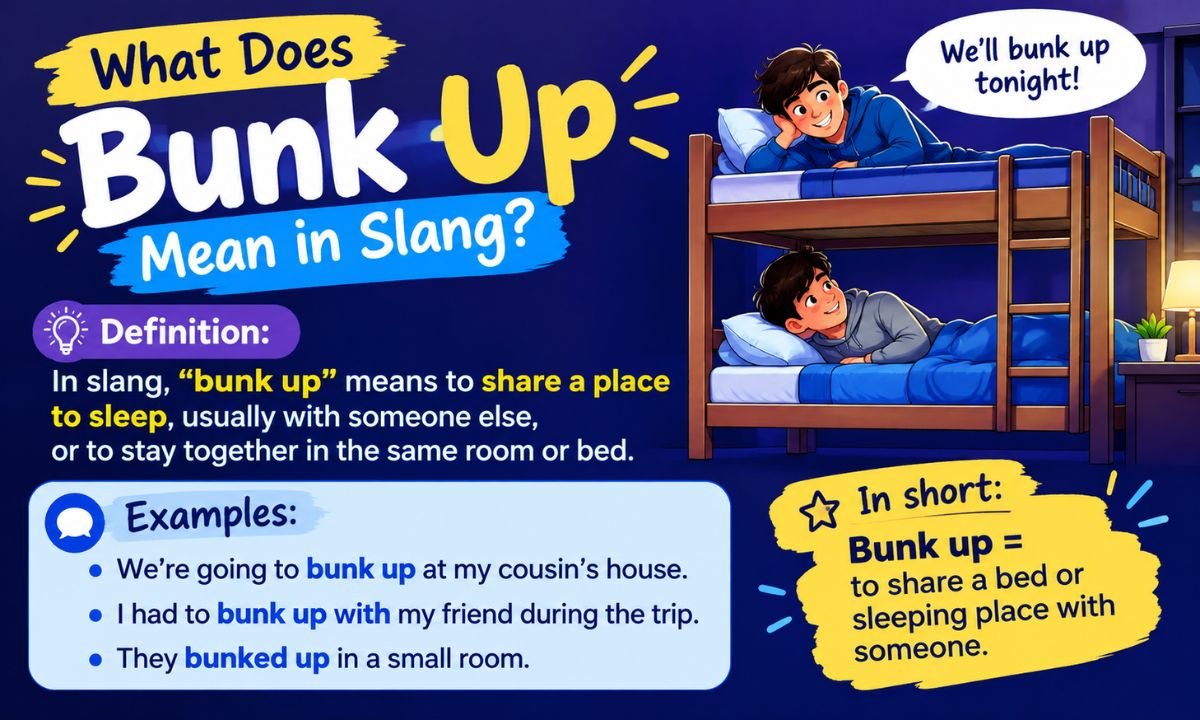
“Bunk up” has a few meanings, and context matters.
- To share sleeping space. “We had to bunk up with another family at the cabin.” This is the most common use.
- A boost. In British English, a “bunk-up” is a push from below to help someone climb over a wall or fence. “Give me a bunk-up!”
- A casual or cheeky hint of intimacy. In some informal British slang, it can carry a suggestive tone. Because of this, it is wise to avoid it in formal writing or mixed company.
What Is Bunk in British Slang?
British English leans heavily on the verb form. The common phrases are:
| Phrase | Meaning | Example |
|---|---|---|
| Bunk off | Skip school or work | She bunked off early on Friday. |
| Do a bunk | Run away, often quickly | The thief did a bunk when he heard sirens. |
| Bunk-up | A physical boost | He gave me a bunk-up over the gate. |
In the UK, “bunking off” is a very familiar phrase for playing truant. Students in Britain, India, and a few other places use it casually.
Does Bunk Mean Skip?
Yes, in British English, bunk can mean to skip, as in skipping class or work without permission. Usually it appears as “bunk off.” In American English, people more often say “skip” or “cut” class, or “play hooky.”
Examples of Bunk in Sentences
Seeing the word in action makes it stick. Here are examples for each meaning.
Bunk as a bed
- The kids argued over who got the top bunk.
- Our cabin has four bunks and a small stove.
- Sailors folded their clothes at the foot of each bunk.
Bunk as nonsense
- Honestly, that so-called miracle cure is bunk.
- Don’t believe everything online. Much of it is bunk.
- His excuse sounded like total bunk.
Bunk as a verb
- You can bunk in the guest room tonight.
- Three friends bunked together during the road trip.
- A few students bunked off after lunch.
- He did a bunk before anyone could ask questions.
Bunk Meaning in American English
In American English, bunk is used mostly for two things: beds and nonsense.
- Bed: “Bunk beds,” “top bunk,” “bunkhouse,” and “bunkmate” are everyday words in the US. Think camps, dorms, and military life.
- Nonsense: People say “that’s a bunch of bunk” in a casual or humorous way. It sounds a bit old-fashioned, which many speakers enjoy.
Americans rarely use bunk to mean skipping class. For that, they usually say “skip” or “ditch.”
Bunk vs. Bunk Bed: What Is the Difference?
The two terms overlap but are not identical.
| Feature | Bunk | Bunk Bed |
|---|---|---|
| What it is | A single sleeping berth, or the word for nonsense | A piece of furniture with beds stacked on top of each other |
| Usage | Ships, trains, camps, slang | Bedrooms, dorms, kids’ rooms |
| Other meanings | Nonsense, to skip, to stay over | Only furniture |
| Example | “I’ll take the lower bunk.” | “We bought a bunk bed for the twins.” |
A simple rule: every bunk bed has bunks, but not every bunk is part of a bunk bed. And a bunk can also be something you say, not something you sleep on.
Synonyms and Other Words for Bunk
Because bunk has several meanings, its synonyms depend on the sense.
| Meaning | Synonyms |
|---|---|
| Bed | berth, cot, bed, sleeping bunk, couchette |
| Nonsense | rubbish, baloney, hogwash, hokum, bunkum, guff, malarkey |
| To stay overnight | crash, stay, sleep, lodge |
| To skip or leave | skip, play truant, play hooky, ditch, flee, scarper |
When you write, pick the synonym that matches the tone. “Hogwash” is playful. “Rubbish” sounds British. “Berth” feels nautical.
Frequently Asked Questions
What is the simple definition of bunk?
Bunk is a narrow bed, nonsense, or the act of sleeping, skipping, or leaving, depending on context.
Where does the word bunk come from?
The “nonsense” sense is short for “bunkum,” which comes from Buncombe County, North Carolina. The bed sense dates back to the 1700s.
Is bunk a formal or informal word?
The bed meaning is neutral and standard. The nonsense and skipping meanings are informal.
What does “that’s bunk” mean?
It means the statement is false or makes no sense.
What does “bunk off” mean?
It means to skip school or work without permission, mainly in British English.
What does “do a bunk” mean?
It means to run away or disappear suddenly, often to avoid trouble.
What does “bunk with someone” mean?
It means to share a room or sleeping space with them.
Is bunk the same as bunk bed?
No. A bunk is one sleeping berth or a slang word, while a bunk bed is the stacked furniture.
Can bunk mean fake or low quality?
Yes, in modern slang it can describe something defective or disappointing.
What is a bunkhouse?
A bunkhouse is a building with several bunks, such as a ranch or camp sleeping quarters.
Conclusion
Bunk is a small word with a big range. It can be a bed on a ship, a nonsense claim you should ignore, or a British way to say you skipped class.
The trick is to read the context. Look at who is speaking, where they are from, and what the sentence is about. Once you do, the meaning becomes clear.
Now you know the bunk definition, its common uses, and how to use it correctly. Try using one of the examples above in your next conversation, and share this guide with anyone learning English.
