

You have probably said “she sleeps like a log” or “it’s as easy as pie” without a second thought. Both are similes. They are small comparisons that make language clearer, warmer, and a lot more fun.
In this guide, you will learn what a simile is, how it differs from a metaphor and an analogy, and how to write your own. You will also find more than 50 similes examples, sorted by use, with meanings you can understand at a glance.
Whether you are a student, a teacher, a parent, or a writer, this page is built to be simple and useful.
What Is a Simile? Meaning and Definition
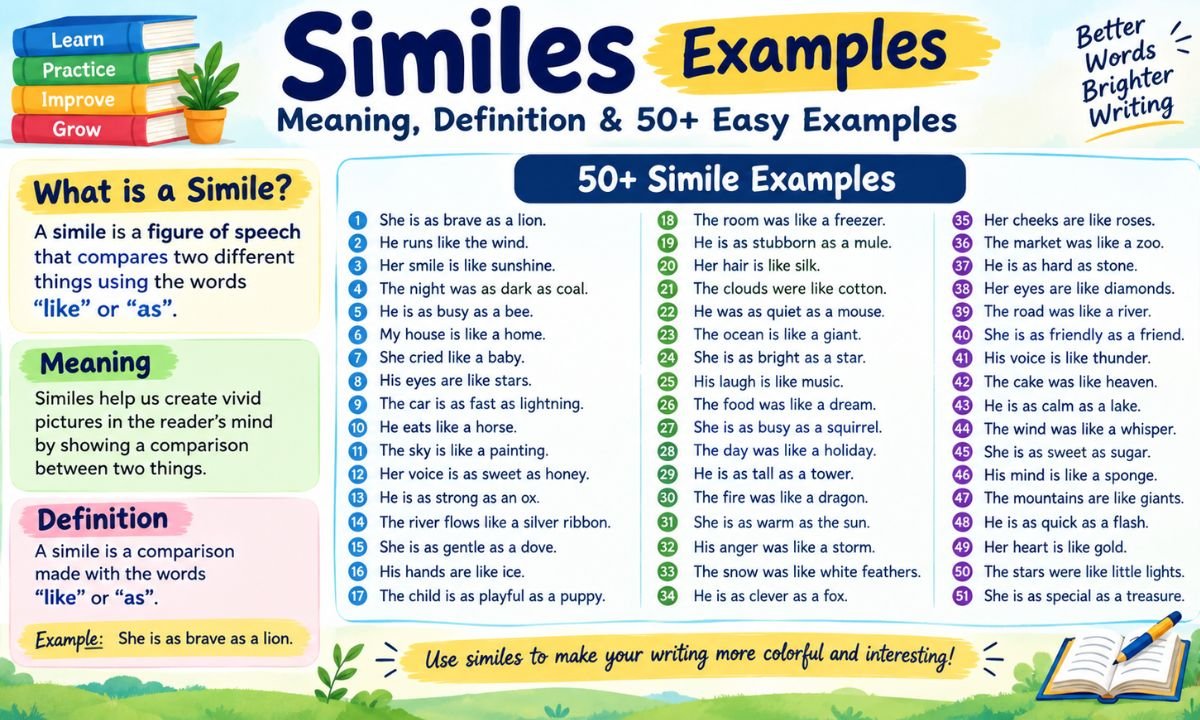
A simile is a figure of speech that compares two unlike things using the word “like” or “as.” The comparison is figurative, not literal. Nobody is really a lion when they are “brave as a lion.”
Quick definition: A simile says one thing is like another so the reader can picture it faster.
Read More:What Does Emphasize Mean? Definition, Examples & Easy Explanation
Where the Word Comes From
The word “simile” comes from the Latin similis, which means “similar” or “like.” That is an easy memory trick. A simile points out what two things have in common.
Why Writers and Speakers Use Similes
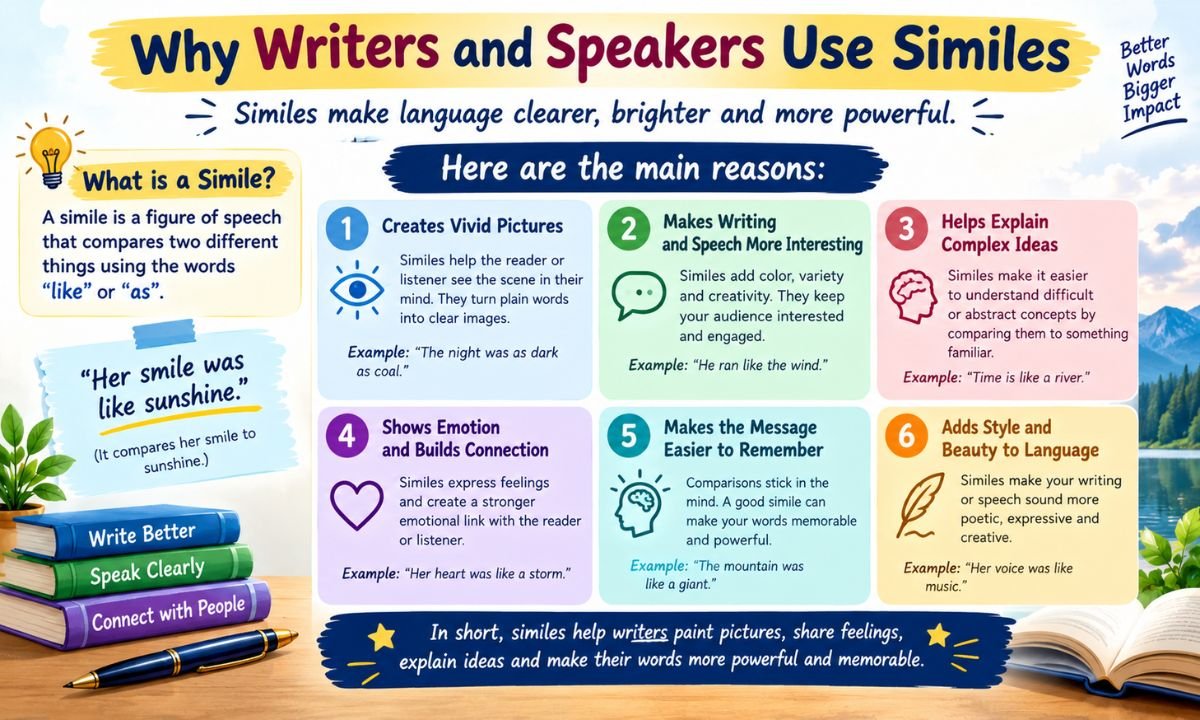
Similes do real work in a sentence. They:
- Create a clear picture in the reader’s mind
- Explain something unfamiliar by linking it to something familiar
- Add emotion, humor, or emphasis
- Make writing sound natural and memorable
The Simile Formula
Most similes follow one of two patterns:
- Like pattern: subject + verb + like + comparison (He ran like the wind.)
- As…as pattern: subject + as + adjective + as + comparison (She is as quiet as a mouse.)
Some similes also use “than,” as in “quieter than a mouse.” A few use phrases such as “resembles” or “seems like.”
Main Types of Similes
| Type | What It Means | Example |
|---|---|---|
| Explicit simile | States the shared quality clearly | As cold as ice |
| Implicit simile | Leaves the quality for you to infer | He fought like a lion |
| Negative simile | Shows how two things are not alike | Nothing like the sun |
| Extended (epic) simile | Stretches over several lines | Common in epic poetry |
Funny Similes Examples
Humor is where similes shine. A silly comparison makes people smile and remember your point.
Here are ten funny similes you can use in stories, speeches, or jokes:
- He was as nervous as a cat in a room full of rocking chairs.
- My phone battery drops like a stone.
- She laughed like a squeaky door.
- The meeting was as exciting as watching paint dry.
- He ate like a vacuum cleaner at a crumb factory.
- My brain feels like a browser with forty tabs open.
- The toddler ran around the house like a tiny tornado.
- His singing was as smooth as a gravel road.
- I’m as lost as a penguin in a desert.
- The traffic moved like cold honey.
Tip: Funny similes work best when the comparison is surprising but still easy to picture.
Simile vs. Metaphor
People mix these two up all the time. Both compare unlike things. The difference is in how they do it.
- A simile uses “like” or “as.” It says something is like something else.
- A metaphor skips those words. It says something is something else.
Many writing experts also note that a simile is really a kind of metaphor. So every simile is a metaphor in the broad sense, but not every metaphor is a simile.
| Feature | Simile | Metaphor |
|---|---|---|
| Comparison words | Uses “like,” “as,” or “than” | Does not use them |
| Directness | Softer, more open | Stronger, more direct |
| Example | Her smile is like sunshine. | Her smile is sunshine. |
| Example | He is as brave as a lion. | He is a lion. |
| Effect | Easy to follow | Bold and poetic |
Quick test: Look for “like” or “as.” If you see one, it is a simile. If the comparison stands without them, it is a metaphor.
Simile vs. Analogy
An analogy is bigger than a simile. It compares two things to explain an idea, often at length. A simile just paints a quick picture.
For example, a simile might say, “The mind is like a garden.” An analogy would go on: “A garden needs water, sunlight, and weeding. In the same way, the mind needs rest, learning, and care.”
| Feature | Simile | Analogy |
|---|---|---|
| Purpose | Describe or add color | Explain or persuade |
| Length | One short phrase | A sentence, a paragraph, or more |
| Uses “like” or “as” | Always | Not required |
| Example | Busy as a bee | Learning to code is like learning a language: grammar first, fluency later |
Think of “analogy” as the umbrella term. Similes and metaphors are tools you can use inside one.
Common Similes and Their Meanings
These are the similes you will hear most in daily English. Learning the meaning behind each one helps you use it correctly.
| Simile | Meaning |
|---|---|
| As busy as a bee | Very active and hard-working |
| As cold as ice | Extremely cold, or unfriendly |
| As quiet as a mouse | Very silent |
| As strong as an ox | Powerful and sturdy |
| As light as a feather | Very light in weight |
| As sharp as a tack | Quick-minded and clever |
| As clear as crystal | Very easy to understand |
| As good as gold | Well-behaved |
| As blind as a bat | Unable to see well |
| As brave as a lion | Courageous |
| As slow as a snail | Very slow |
| As stubborn as a mule | Unwilling to change one’s mind |
| As flat as a pancake | Completely flat |
| As cool as a cucumber | Calm under pressure |
| As happy as a clam | Very content |
Note: Some of these are clichés now. They are fine for speaking and for young learners, but fresh comparisons usually make stronger writing.
Simile Examples Using “Like”
The “like” pattern is the simplest way to build a simile. Here are ten examples with their meanings.
- She sleeps like a log. She sleeps very deeply.
- He eats like a bird. He eats very little.
- They fought like cats and dogs. They argued constantly.
- The baby slept like an angel. The baby was peaceful.
- He works like a machine. He works without stopping.
- She swims like a fish. She is an excellent swimmer.
- He ran like the wind. He ran extremely fast.
- The news spread like wildfire. It travelled quickly.
- Her voice sounded like music. Her voice was pleasant to hear.
- He felt like a fish out of water. He felt out of place.
Notice how each one gives you a feeling in just a few words. That is the strength of a good simile.
Simile Examples in Everyday Language
We use similes all day without noticing. They show up in conversations, advertising, sports talk, and social media.
At Home and Work
- My morning felt as long as a Monday.
- The kitchen smelled like a bakery.
- Our manager was as calm as a still lake.
- The deadline hit me like a ton of bricks.
- The office was as quiet as a library.
With Feelings and Friends
- I was as happy as a child on the last day of school.
- She felt like she was walking on air.
- His words stung like a bee.
- We were as close as two peas in a pod.
- My nerves were like jelly before the test.
Everyday similes help us sound expressive without trying too hard. They are also a big reason English feels so colorful.
Simile Examples in Literature
Great writers have relied on similes for centuries. Here are a few well-known examples from works in the public domain.
- Robert Burns compared love to a red, red rose in his famous poem. The simile suggests love that is fresh, bright, and new.
- William Wordsworth wrote that he “wandered lonely as a cloud.” The simile shows his freedom and his solitude at once.
- William Shakespeare used a negative simile in Sonnet 130, saying his mistress’s eyes are nothing like the sun. The twist makes the poem honest, not flattering.
- Psalm 1 describes a faithful person as being like a tree planted by streams of water. The simile points to steady growth and strength.
- Isaiah 40:31 speaks of those who trust in God rising up with wings like eagles. The comparison paints hope and renewed strength.
Why Literary Similes Work
In stories and poems, a simile does more than decorate. It shapes tone, deepens a character, and helps readers feel the scene. A single comparison can say what a full paragraph might struggle to explain.
Poets also use epic similes, also called Homeric similes. These run for several lines and give a whole scene extra weight.
How to Write a Simile
You do not need to be a poet. Follow these steps and you can write a fresh simile in minutes.
- Pick your subject. Decide what you want to describe, such as a storm, a feeling, or a person.
- Choose the quality. Ask what you want to stress: speed, size, softness, fear, or joy.
- Find something that shows that quality strongly. Think of a clear, vivid image.
- Connect them with “like” or “as.” Build your sentence.
- Check that it is clear. If the reader has to work hard to see it, simplify.
- Read it aloud. A good simile sounds natural.
Do’s and Don’ts
| Do | Don’t |
|---|---|
| Use fresh, specific images | Rely only on worn-out clichés |
| Keep it short and clear | Pile several similes in one sentence |
| Match the tone of your writing | Use a silly simile in a serious passage |
| Compare unlike things | Compare two similar things (that’s not a simile) |
Example of improving a simile:
- Weak: He was as tall as a tree.
- Stronger: He stood like a streetlamp over the crowd.
The second one adds a picture and a mood. That is the goal.
Simile Examples for Students
If you are learning figurative language in school, practice is the fastest route. Here are ten student-friendly similes.
- The classroom was as noisy as a beehive.
- My backpack feels like a bag of rocks.
- The teacher’s voice was as gentle as a breeze.
- The test was as easy as pie.
- He shot up his hand like a rocket.
- The playground was as busy as an anthill.
- Her handwriting looks like tiny footprints.
- The snow fell like soft cotton.
- My friend is as loyal as a puppy.
- The bell rang like an alarm clock.
Quick Practice Activity
Finish each sentence with your own comparison:
- The moon was as bright as ______.
- My little brother runs like ______.
- The soup was as hot as ______.
- Her smile was like ______.
Teaching tip: Ask students to hunt for similes in their favorite books and songs. Spotting them in real writing builds confidence quickly.
Frequently Asked Questions
What is a simile in simple words?
A simile compares two different things using “like” or “as” to make a description clearer.
What is an example of a simile?
“She is as brave as a lion” is a simple example.
What words are used in similes?
Most similes use “like” or “as.” Some also use “than.”
What is the difference between a simile and a metaphor?
A simile uses “like” or “as.” A metaphor states that one thing is another.
Is “as tall as a tree” a simile?
Yes. It compares height to a tree using “as…as.”
Is “He is as tall as me” a simile?
No. That is a literal comparison between two similar things, not a figurative one.
Why do writers use similes?
They make writing vivid, relatable, and easier to remember.
Are similes only used in poetry?
No. They appear in stories, speeches, ads, songs, and daily conversation.
What is a cliché simile?
It is a simile used so often it has lost its freshness, such as “cold as ice.”
How many types of similes are there?
Common types include explicit, implicit, negative, and extended similes.
Conclusion
A simile is one of the easiest and most powerful tools in language. With just “like” or “as,” you can turn a flat sentence into a picture. You have now seen the definition, the key differences from metaphors and analogies, and more than 50 similes examples you can use right away.
The best way to improve is to practice. Pick one scene from your day and describe it with a fresh simile. Share it, read it aloud, and keep what feels natural.
Bookmark this guide and come back whenever you need a quick example, a clear meaning, or a little inspiration.
