

You open a group chat and see: “Okay, who has the tea?” If that message left you puzzled, you’re in good company. In slang, tea means gossip, juicy news, or the real story behind something. It shows up in TikTok comments, Instagram captions, DMs, and even family chats.
This guide explains the tea slang meaning in plain English. You’ll learn how people use it in texts and on social media, where it came from, and when it can sound out of place.
What Does Tea Mean in Slang?
Quick answer: Tea is slang for gossip or inside information, usually the interesting or dramatic kind.
Example: “Did you see what happened at the party? I need all the tea.”
Here are a few words that point to the same idea:
- Gossip
- Scoop
- Drama
- Rumors
- Juicy details
- Inside information
The word can also carry a hint of “truth,” which is part of its history (more on that below). Most people today simply use it to mean “the latest story worth hearing.”
What Does Tea Mean in Texting?
In text messages, DMs, and group chats, tea works as a short, friendly way to ask for or share gossip. It fits the quick, casual rhythm of chatting.
Common ways people use it:
- Asking: “What’s the tea?”
- Announcing: “I have tea. Call me.”
- Reacting: “Wait, that’s the tea!”
- Teasing: “Not texting this. Too much tea.”
Most people type it in lowercase and add an emoji or two. It’s best for friends and informal chats. In a work email or a message to a teacher, plain language is safer.
What Does Tea Mean on TikTok, Instagram, and Snapchat?
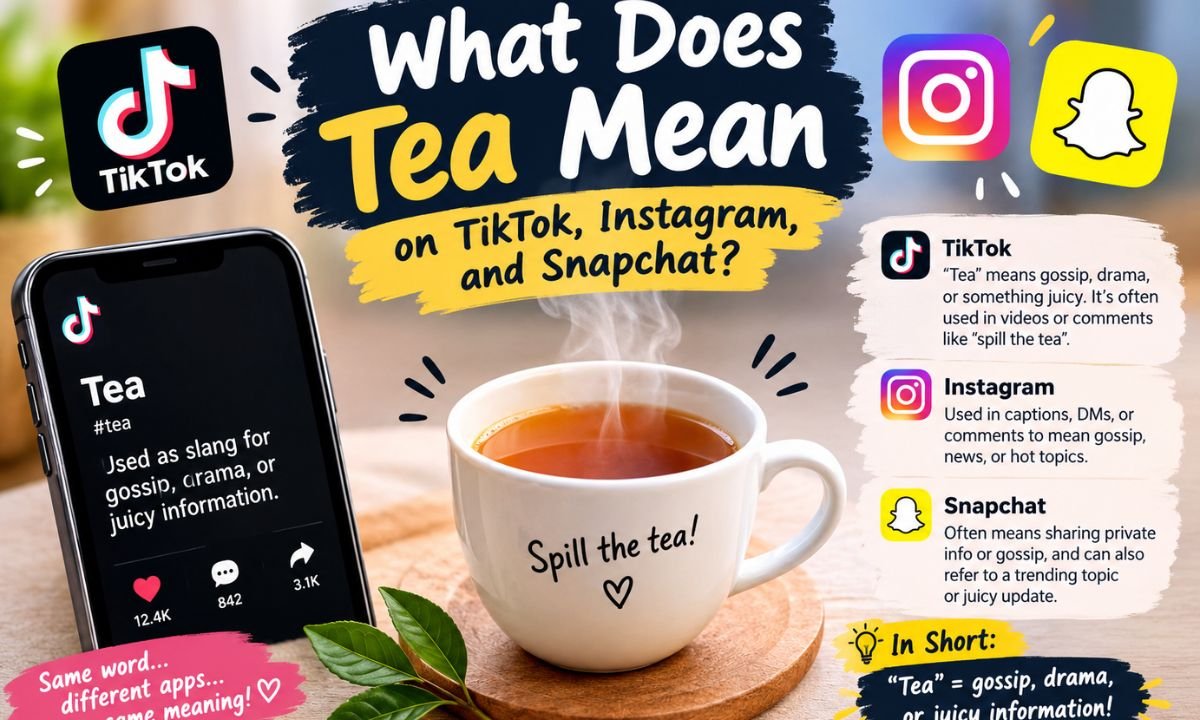
On social media, tea covers any gossip, hot take, or behind-the-scenes story. Creators use it to hook viewers, and commenters use it to ask for more details.
| Platform | How people use tea |
|---|---|
| TikTok | Storytime videos, “spilling the tea” captions, and comments like “okay but spill” |
| Captions, Story polls, Close Friends posts, and comments such as “the tea is teaing” | |
| Snapchat | Quick snaps with “I have tea,” usually followed by a call or voice note |
| X (Twitter) | Threads that break down a controversy or a celebrity moment |
Not all online tea is equal. Fans often describe it in three levels:
- Hot tea: Fresh, surprising gossip.
- Good tea: Entertaining, but less shocking.
- Weak tea: Old news, common knowledge, or a story that may not be true.
One caution: tea on social media often has no proof behind it. Treat it as a rumor until you see something reliable.
What Does “Spill the Tea” Mean?
“Spill the tea” means to share gossip or reveal private information. It’s close to “spill the beans,” but tea leans toward personal stories and drama rather than simple secrets.
What Does “What’s the Tea?” Mean?
It’s a casual way to ask, “What’s going on?” or “What’s the latest gossip?” You might send it when you sense a friend has news.
What Does “That’s the Tea” Mean?
People say it to confirm that something is true or that a point is spot-on. Used alone as “Tea!”, it’s also a reaction to a surprising piece of news.
What Does “No Tea, No Shade” Mean?
It’s a disclaimer people add before a comment, as in “No tea, no shade, but that outfit was bold.” It tells the listener, “I’m not gossiping or trying to insult anyone.” Shade means a subtle insult, so the phrase is meant to soften what comes next. Some people use it sincerely, and others use it to slip in a dig.
How to Use Tea Slang in a Sentence
Tea works as a noun (“I have tea”), and it appears in set phrases like “spill the tea.” Here are examples you can adapt.
Examples of Tea Slang in Text Messages
- “Girl, what’s the tea from last night?”
- “I have tea. Are you free to talk?”
- “He actually said that? That’s the tea.”
- “Spill the tea before I lose my mind.”
- “No tea, no shade, but I think she’s moving.”
Examples of Tea Slang in Everyday Conversations
- “Whenever she visits, she brings the best tea about the neighborhood.”
- “I’m not here for the drama, but I’ll happily sip my tea and watch.”
- “Okay, spill the tea. How did the interview go?”
- “That show gave me so much tea in one episode.”
Where Did Tea Slang Come From?
Most language experts trace “tea” to Black gay and drag culture in the United States. In that setting, “T” stood for truth, and “spill the T” meant telling the real story.
A few points are widely cited:
- Printed uses with the “truth” meaning appear by the early 1990s.
- John Berendt’s 1994 book Midnight in the Garden of Good and Evil helped introduce the sense to a wider audience.
- RuPaul’s Drag Race, which began in 2009, spread the phrase to mainstream viewers.
- Reality TV, Twitter, and later TikTok carried it into everyday online speech.
The teacup image came afterward, as a playful twist on the letter T. Some people also link it to old stereotypes of gossip at tea parties, but that idea is less certain. The exact origin is still debated, and it’s fair to credit the communities that created and shaped the phrase.
Is Tea Slang Positive, Negative, or Rude?
On its own, tea is neutral. The tone depends on what you’re talking about and who you’re talking to.
| Situation | Tone |
|---|---|
| Sharing exciting news about a friend’s good luck | Positive, playful |
| Chatting about a TV show or celebrity moment | Neutral, light |
| Passing along unverified rumors about a coworker | Negative, risky |
| Spreading private details about someone’s health or family | Rude and potentially harmful |
Tea can sound inappropriate when:
- The story is private or painful for the person involved.
- You’re at work or in a formal setting.
- You can’t back up what you’re saying.
- The “tea” is really a way to put someone down.
A simple rule: if you wouldn’t say it with the person in the room, think twice before spilling it.
What Does the Tea Emoji ☕ Mean in Text?
People use ☕ (and the teacup 🍵) to signal that they’re watching gossip unfold. It suggests curiosity, amusement, or “I’m just here for the drama.”
You’ll often see it in these ways:
- After a juicy comment: “She really said that ☕”
- With eyes: “☕👀” means “I’m watching this closely.”
- As a hint: Posting only an emoji to tease that you know something.
The emoji pairs well with the “sipping tea” idea, where someone watches an argument from the sidelines without joining in.
Read More: Read More: ATP Meaning Slang Twitter: What Does ATP Mean in Text?
FAQs About Tea Slang
Does Tea Mean Gossip?
Yes. In slang, tea mostly means gossip, juicy news, or inside information.
What Does “Spill the Tea” Mean in Text?
It’s a request or invitation to share gossip or the full story. “Spill the tea” in a text means “tell me everything.”
What Does “I Have Tea” Mean?
It means the person has gossip or news to share. It’s usually a hint that the story is interesting.
Is Tea Slang Still Popular?
Yes. It has stayed in everyday use online for years, and most people still understand it right away.
Conclusion
Tea is simple once you know the pattern: it means gossip, news, or the real story. People use it to ask questions, tease news, and react to drama in texts and on social media. Use it with friends, pay attention to tone, and be careful about spreading rumors. Understand its roots, and you’ll use it with more confidence and respect.
