

You have probably seen a lone _ in a chat, a caption, or a username and wondered if it was some new slang. It is not. The underscore is a keyboard symbol, and on its own it has no secret or universal slang meaning in text messages.
What it does have is a handful of everyday jobs: separating words in usernames, marking blanks, showing emphasis in some apps, and forming faces in emoticons. This guide explains each of those uses with real examples, so the next time you wonder what does _ mean in text, you will know exactly how to read it.
_ Meaning in Text – Quick Meaning
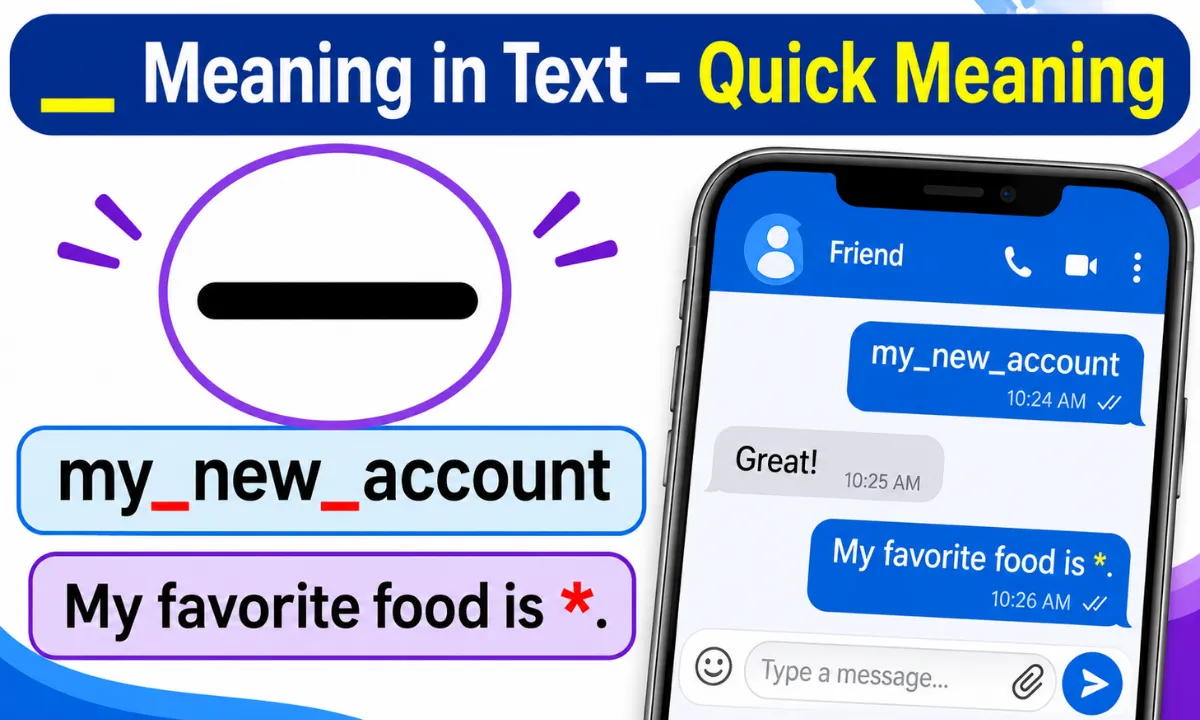
In text, _ is the underscore symbol. It is a horizontal line that sits at the bottom of a line of text, and it is used for spacing, formatting, and as a placeholder. It does not stand for a feeling, a code word, or a hidden message by itself.
When someone sends a message with an underscore, the meaning comes from where it appears. In a username it replaces a space. In a sentence it usually marks a missing word or a bit of formatting.
Read Also This: DWBI Meaning in Text: Full Form and How People Use It
Example Usages
Here are the most common ways you will see it in everyday messages:
- Usernames: “Follow me at
sara_designson Instagram.” - Blanks: “My favorite food is _.” (the person wants you to fill in the answer)
- Emphasis in some apps: “That movie was amazing.” (WhatsApp turns text between underscores into italics)
- Emoticons: “Ugh, Monday again o_o”
What Is _ in Text?
In text, _ is a character, not a word. It is part of the basic set of symbols found on almost every keyboard, and it appears in messages, handles, file names, email addresses, and web links.
People rarely send it alone. Most of the time it is tucked inside a word or a string of characters, and its job is practical. If you see a single underscore sitting by itself in a message, it is most likely a blank to fill in, a typo, or part of a formatting attempt that did not work.
What Is the Meaning of _?
The standard meaning of _ is simply “underscore,” a line drawn at the base of the text. Its meaning is functional: it connects, separates, or fills a gap. It is not an abbreviation like “LOL” or “BRB.”
Some readers try to find an emotional meaning in it, such as sadness or sarcasm. There is no such standard meaning. The only time an underscore carries a feeling is when it is part of an emoticon like T_T, and in that case the whole face is what shows the emotion, not the underscore alone.
What Are _ Used For?
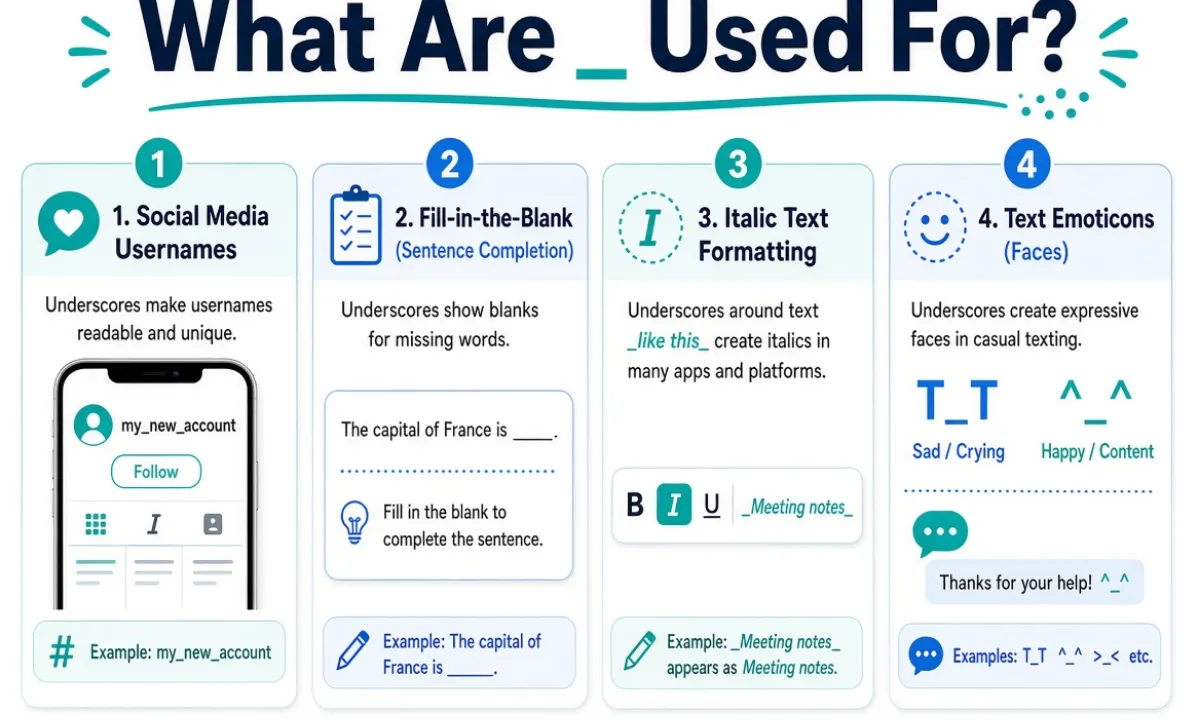
The underscore has a few clear, practical uses in digital communication. Knowing them helps you tell a normal use from something odd.
- Joining words where spaces are not allowed, such as
my_new_account - Showing a blank or a missing word in quizzes and fill in the blank posts
- Wrapping text for italics in apps that support it
- Building the mouth or nose in text faces like
^_^ando_o - Hiding or replacing a letter in a word, such as “what the h_ll,” to soften a strong word
The last use is a form of light censoring. The reader fills in the missing letter, and the underscore simply shows where it was.
What Is Another Word for _?
The most common name is “underscore.” In technical writing you may also see “low line,” which is the official character name, and “underbar,” a less common term. The Unicode Standard, which assigns names to characters used across devices, lists it as <a href=”https://www.unicode.org/charts/PDF/U0000.pdf” rel=”nofollow”>LOW LINE in the Basic Latin chart</a>.
Do not mix it up with “underline.” An underline is a formatting style applied under existing letters, while an underscore is a separate character you type on its own line of text.
What Is the Under _ Symbol?
People searching for the “under _ symbol” are usually asking about the underscore key, since the symbol sits below the baseline of the text. On most keyboards you type it by holding Shift and pressing the hyphen key, which is next to the zero key on a standard US layout.
On a phone, open the numbers and symbols keyboard. Depending on your phone, the underscore may be on the first symbols page or on a second symbols page. If you cannot find it, long pressing the hyphen key sometimes shows it as an option.
Origin & Background
The underscore began on typewriters. Since a typewriter could not underline text on its own, typists would backspace and type the underscore character over the words they wanted to emphasize.
When computers arrived, the character was included in ASCII, the early standard for text on computers, where it has the code 95. Programmers soon found it useful for names that could not contain spaces, such as file names and variable names. From there it moved into email addresses, web addresses, and social media usernames, which is why it feels so familiar online today.
Real-Life Conversations
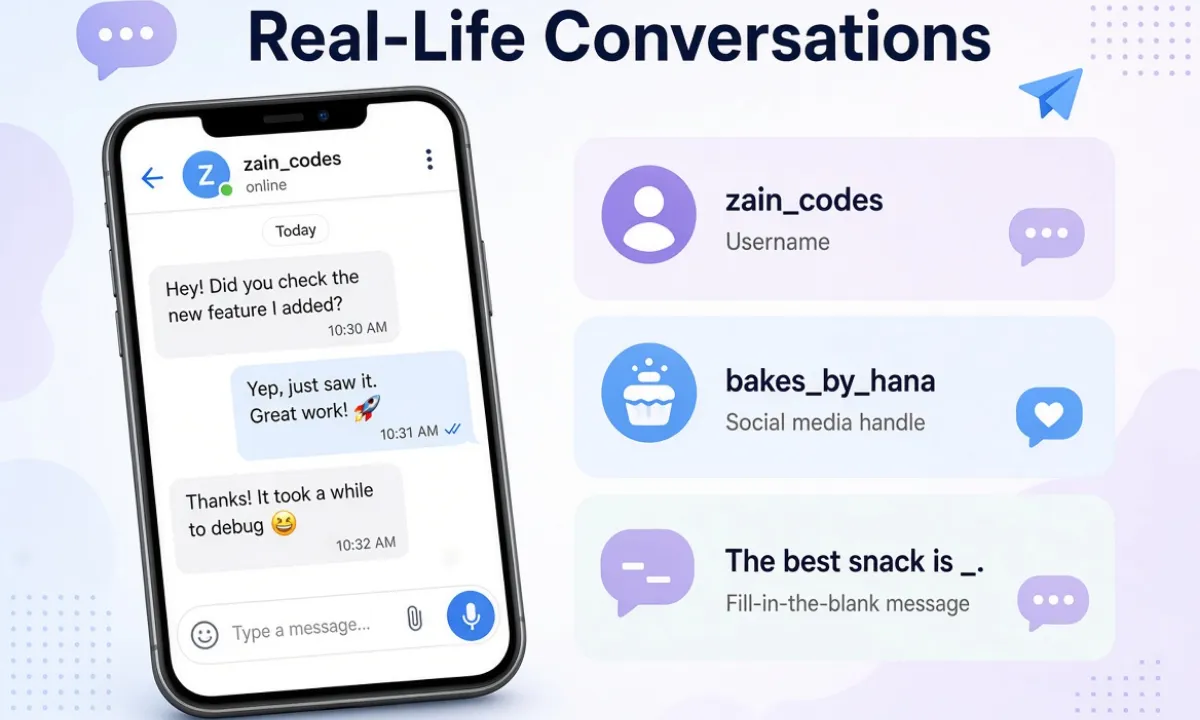
Real chats show how the underscore behaves far better than a definition does. Here are four everyday examples across different apps.
Conversation 1 (WhatsApp)
Maya: “Quick question, what is your Insta? I want to tag you.”
Zain: “It is zain_codes, with the underscore in the middle.”
Maya: “Got it. I kept leaving it out and the profile would not load.”
Here the underscore is a required part of the name. Without it, the account does not exist.
Conversation 2 (Instagram DM)
Lena: “Just saw your story. Who made that cake?”
Omar: “My sister! Her page is bakes_by_hana.”
Lena: “Following her right now.”
This is the most common real world use: a handle that needs a separator between words.
Conversation 3 (TikTok Comment)
User A: “Finish this sentence: The best snack ever is _”
User B: “Popcorn. Easy.”
User C: “Spicy chips, no debate.”
The underscore marks the blank. People answer in the comments, which boosts engagement on the video.
Conversation 4 (Text Message)
Dad: “Dinner is at 7. Bring _ for dessert.”
Chloe: “You forgot to type what to bring, Dad.”
Dad: “Ha, I meant to write ice cream. The keyboard cut it off.”
The underscore here was a typing slip, not a code. Messages like this are why it helps to ask instead of guessing.
Emotional & Psychological Meaning
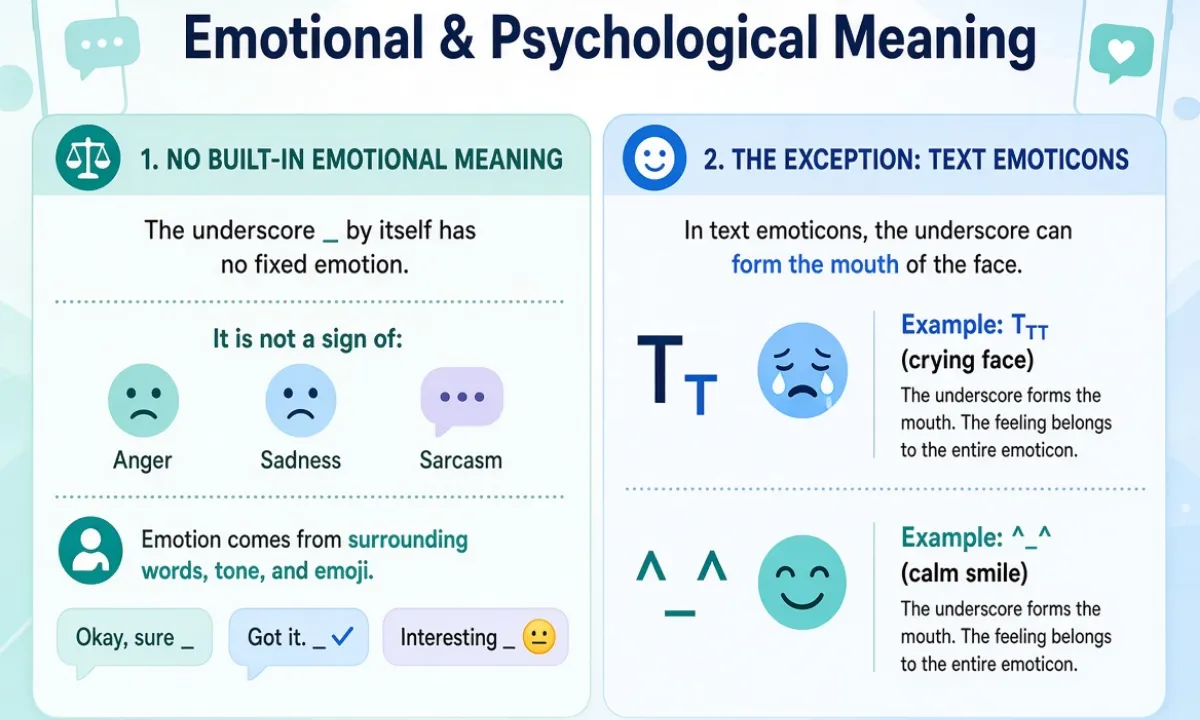
The underscore has no built in emotional meaning. It is not a sign of anger, sadness, or sarcasm, and reading a mood into a single symbol usually leads to confusion. Emotion shows up in the words, the tone, and the emoji around it.
The one exception is emoticons, where the underscore is a part of a drawn face. In T_T it forms the mouth of a crying face, and in ^_^ it forms a calm smile. The feeling belongs to the entire face.
Real-Life Style Scenario
Imagine a friend texts, “Great, another group project o_o.” The underscore is not the source of the feeling here. The friend is showing mild shock or worry through the whole face, and the words “another group project” tell you the reason.
If the same friend sent “Great, another group project,” with no face, you would read it differently. The symbols helped set the tone, but only as part of a pattern.
Usage in Different Contexts
The meaning of an underscore shifts slightly with the place it appears. The symbol stays the same, but its job changes.
Social Media
On Instagram, TikTok, X, and Snapchat, the underscore is mostly used in handles. It helps people create a readable name when their first choice is already taken, for example emma_travels instead of emmatravels. In captions and comments, it can also be used for fill in the blank posts.
Friends & Relationships
Between friends, you will see it in playful emoticons and sometimes as a mild censor in words like “d_mn.” It is not a signal of closeness or distance. If a partner or friend uses it, check the surrounding message before deciding what they meant.
Work / Professional Settings
At work, the underscore shows up in file names, email addresses, and project codes, such as Q3_report_final.pdf. It keeps names tidy when spaces cause problems. It is rarely used in the body of a professional message, and emoticons like o_o would look out of place.
Casual vs Serious Tone
In casual chats, an underscore inside an emoticon adds a bit of humor or exaggeration. In serious or formal messages, it should only appear where it is functionally needed, like a username or a file name. If a message is meant to sound serious, leave the face out.
When NOT to Use It
Avoid the underscore in formal emails, school essays, cover letters, and official documents, where it can look like a mistake. Do not use blanks like _ in a message where someone might think your text was cut off by accident.
Also avoid using it as a replacement for a real word when clarity matters. If you are sharing an address, a password hint, or a time, spell the whole thing out so there is no doubt about what you meant.
Common Misunderstandings
One common mistake is thinking the underscore is a secret code. It is not, and no major app uses it as a hidden signal. Another is assuming that two underscores or three mean something more intense. They are just longer lines, often used as a visual blank.
People also confuse it with the hyphen or with a dash. They look similar at a glance, but they are different characters used for different tasks. A last misunderstanding is believing that an underscore at the end of a message means the sender is upset. In most cases the sender simply typed a symbol by accident or left a blank.
Comparison Table
This table shows how the underscore differs from other symbols that people often mix it up with.
| Symbol | Name | Typical Use | Example |
|---|---|---|---|
_ | Underscore | Usernames, blanks, file names, emoticons | john_smith |
- | Hyphen | Joining words, phone numbers, dates | “well known” |
/ | Slash | Choices, dates, web addresses | “and/or” |
. | Period | Ending sentences, web addresses | “example.com” |
* | Asterisk | Bold text in some apps, footnotes | “important“ |
Variations / Types
The underscore appears in a few common forms, and each one has a slightly different use.
- Single underscore:
_for usernames, blanks, and emoticons - Double underscore:
__for longer blanks or a visual divider - Leading underscore:
_namein code and some usernames - Trailing underscore:
name_in usernames when the plain version is taken - Wrapped text:
_word_for italics in apps like WhatsApp - Emoticon forms:
o_o,T_T,^_^, and-_-
How to Respond When Someone Uses It
Your reply depends on what the underscore was doing. If it was a blank, answer the question. If it was a username, repeat it back to make sure you typed it correctly. If it was an emoticon, respond to the feeling it showed.
Casual Replies
“Ha, I see the blank! My answer is pizza.”
“Got it, I will search for that name with the underscore.”
Funny Replies
“That blank is begging for a fun answer, so I filled it with tacos.”
“Your face o_o made me laugh. What happened?”
Mature Replies
“I think part of your message got cut off. Could you resend it?”
“Thanks for sending the username. I will double check the spelling.”
Respectful Replies
“Sorry, I am not sure what you meant by the underscore. Can you explain?”
“Thank you for clarifying. I understand now.”
Regional & Cultural Usage
The underscore itself is the same everywhere, since it comes from the same keyboard and character set. What changes from place to place is how often it is used and which emoticons are popular.
Western Culture
In the US, UK, and Canada, the underscore is mostly seen in usernames, email addresses, and fill in the blank posts. It is also used in markdown style formatting by people who write in apps that support it.
Asian Culture
In Japan, Korea, and China, text faces are widely used in online chat, and the underscore often appears in them, for example ^_^ for a smile. These emoticons were popular on early internet forums and messaging apps, and many people still use them.
Middle Eastern Culture
Arabic and Persian are written in their own scripts, but many people in the region use Latin letters for usernames on global platforms. In that case, the underscore works the same way it does elsewhere, helping to join words in a handle.
Global Internet Usage
Across the internet, the underscore is a universal technical character. It is accepted in most usernames, domain related tasks, and file names, so people worldwide meet it in the same few places.
Generational Differences
Older users often see the underscore as a typing or file naming tool, since they grew up with email and early computers. Younger users are more likely to use it in handles and emoticons, and to see it in short video comments and captions.
Is It Safe for Kids?
Yes. The underscore is a harmless keyboard symbol with no inappropriate meaning. Children will meet it in usernames, game names, and school files, and there is nothing in it that needs a warning.
Parents should keep in mind that safety depends on the content and the person behind a message, not on the symbol. If a child is chatting with someone unfamiliar, the same care applies whether the username has an underscore or not.
FAQs
1. What Does _ Mean at the End of a Sentence?
It usually means a blank or a missing word. For example, “My favorite color is _” asks the reader to fill it in. It can also be a typing mistake or a part of an emoticon, so check the sentence before deciding.
2. Is Underscore a Punctuation Mark?
Technically, it is classified as a punctuation or symbol character in computing, but it is not used as a normal punctuation mark in standard writing. It does not end sentences or separate clauses like a period or comma does.
3. Why Do People Use Underscore in Usernames?
Most platforms do not allow spaces in usernames. The underscore acts as a stand in for a space, which makes names easier to read, like travel_with_ali. It also helps people get a name that is close to their first choice when the plain version is taken.
4. Does Underscore Have Emotional Meaning?
No. The underscore itself does not express emotion. A feeling only appears when it is part of an emoticon like T_T or o_o, and then the whole face carries the emotion.
5. Can Underscore Change the Meaning of a Message?
It can, but only through its function. A blank changes a statement into a question, and wrapping a word in underscores can turn it into italics in some apps. A missing underscore in a username can also send someone to the wrong account.
6. Is Underscore Used in Formal Writing?
Rarely. It appears in file names, web addresses, and technical documents, but it is not part of formal prose. In essays, reports, and official letters, you should avoid it.
7. What Is the Difference Between Underscore and Dash?
An underscore sits low on the line and joins words in usernames or file names, while a dash or hyphen sits in the middle of the line and is used in writing to join words or show a range. They are separate characters, and swapping them can break a username or a link.
Conclusion
So, what does _ mean in text? It is simply the underscore symbol, used to connect words in usernames, mark blanks, add emphasis in some apps, and build text faces. It does not carry a hidden emotional message or a universal slang meaning on its own.
The best way to understand it is to look at the place and purpose it appears in. If you are ever unsure, a quick question to the sender clears things up faster than guessing, and now you know what to look for the next time you see one.
