

YK means “You Know.” It’s a casual texting abbreviation people use to express shared understanding, add emphasis, or keep conversations flowing naturally. You’ll see it across text messages, TikTok, Snapchat, Instagram, and casual online spaces where friends chat daily.
What Does YK Mean in Text?
The abbreviation YK is simple: it stands for “You Know.” When someone types “YK,” they’re essentially shortening a phrase most of us use constantly in real conversations “you know” into two letters for faster digital communication.
Think of it as the written equivalent of a knowing nod or casual shoulder shrug. Someone might text: “YK this movie is amazing” instead of typing out the full “You know this movie is amazing.” The meaning stays the same, but typing goes faster, and the message feels more relaxed and conversational.
Why people use it:
- Speed: Two letters replace seven words
- Casual tone: Makes messages feel friendly and less formal
- Modern style: Fits how Gen Z and younger users naturally communicate online
- Relatability: Assumes shared understanding between sender and receiver
The beauty of YK is that it mirrors how people actually talk in everyday speech. Most English speakers naturally say “you know” when explaining something or confirming shared ideas. Texting simply took this natural speech pattern and condensed it into quick shorthand.
Example in Context
Text 1: “That new restaurant opened downtown, YK the one we talked about?”
- Here, YK means the person assumes you remember which restaurant they mentioned.
Text 2: “YK I can’t make it Friday, right? Something came up.”
- In this case, YK signals that the sender hopes you already understand the situation.
Read More: JS Meaning in Text: What Does JS Mean in Chat? Uses, Examples & More
YK Full Form: Breaking It Down
| Aspect | Details |
| Full Form | You Know |
| Most Common Use | Casual texting and social media |
| Tone | Friendly, informal, neutral |
| Capitalization | Usually lowercase (yk), but YK also works |
| Platform Popularity | Snapchat, TikTok, Instagram, WhatsApp, Discord |
| Alternative Meanings | Young King (rare), Yankee (very rare) |
The YK full form is straightforward, yet the abbreviation adapts beautifully across different digital platforms and conversation styles. Whether someone writes “yk” in all lowercase or “YK” in capital letters, the meaning doesn’t change—it’s simply stylistic preference reflecting how different users type.
YK Meaning in Different Contexts
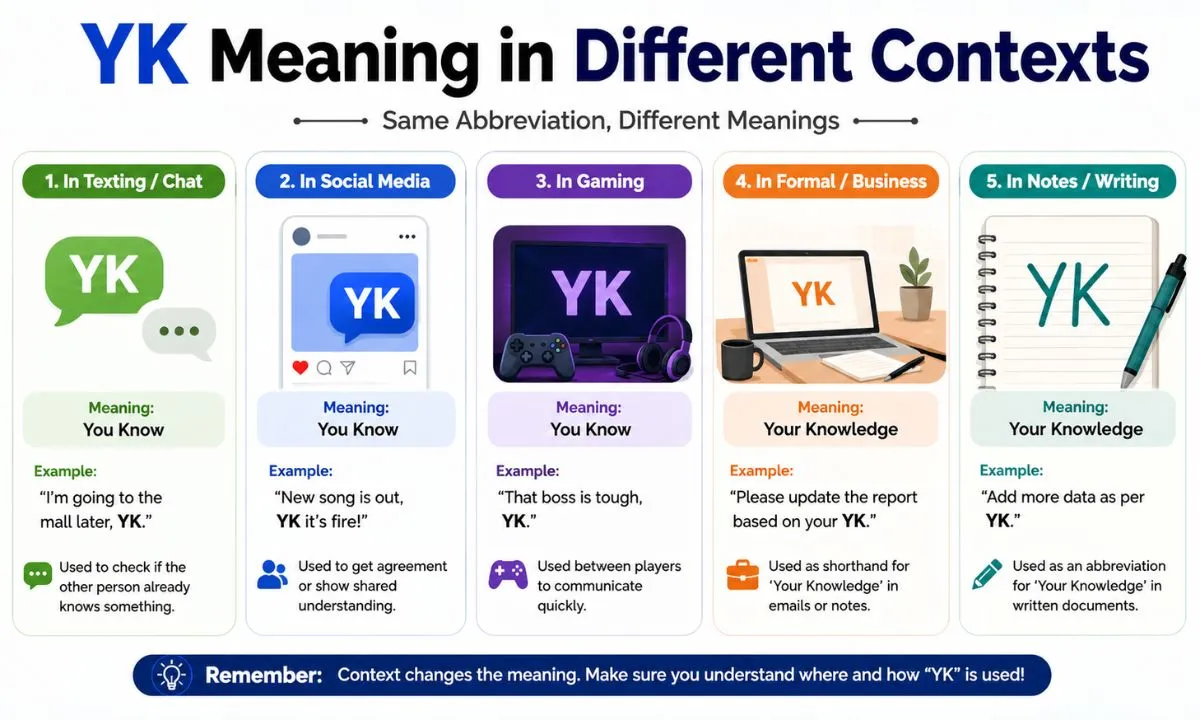
Internet slang isn’t one-size-fits-all. While YK primarily means “You Know,” the way people use it shifts depending on where the conversation happens and who’s involved.
In Text Messages
On personal texting apps like SMS, WhatsApp, or iMessage, YK serves as a conversational filler that confirms mutual understanding.
Examples:
- “Are we still meeting tomorrow, yk?”
- “That coffee shop has the best pastries, yk?”
- “I’ve been exhausted lately, yk how it is.”
Text conversations are typically one-on-one or in small group chats, making YK perfect for intimate, casual exchanges. The abbreviation helps maintain quick response times without sacrificing the friendly tone.
On Snapchat
Snapchat’s ephemeral nature messages and snaps disappear encourages quick, playful communication. YK fits this environment perfectly because Snapchat users value speed and spontaneity.
Snapchat YK Uses:
- Snap captions: “Late to class again, yk 😅”
- Direct messages: “That story was hilarious, yk?”
- Chat threads: “We should hang soon, yk?”
Snapchat culture celebrates informal typing and minimal filters, making YK a staple in the platform’s messaging style.
On TikTok
TikTok creators often use YK in video captions and comments to engage viewers and signal shared experiences or inside jokes.
TikTok Examples:
- Video caption: “This trend is harder than it looks, yk? 💀”
- Comment reply: “Your transition was smooth yk”
- Duet caption: “If you get this reference, yk you’re a true fan”
On TikTok, YK helps creators feel more connected to their audience by assuming collective understanding or shared humor.
On Instagram
Instagram combines visual content with text, and YK appears in captions, comments, and direct messages to keep tone casual and relatable.
Instagram Usage:
- Caption: “New outfit, who dis? YK you already know the vibe 🖤”
- Comment: “This photo is fire yk”
- DM: “Seen that new reel? Yk it was perfect”
Instagram’s aesthetic-focused culture means YK often accompanies trendy photos or fashion posts, adding personality without cluttering captions.
In Gaming Chats
Gamers use YK in Discord servers, in-game voice channels, and gaming communities to coordinate quickly while maintaining camaraderie.
Gaming Context:
- “YK the strategy we planned?”
- “That move was risky yk?”
- “Meet at spawn point, yk?”
In competitive or cooperative gaming, speed matters, making YK ideal for rapid-fire communication between teammates.
Is YK Rude, Offensive, or Neutral?
The short answer: YK is neutral and friendly. It’s casual internet slang, not an insult or offensive term.
Different Emotional Tones
| Tone | Example | Context |
| Friendly | “That party was wild, yk? Let’s do it again!” | Positive, enthusiastic |
| Playful | “You think you’re funny, yk 😏” | Joking, lighthearted |
| Slightly Annoyed | “YK you said you’d text me back” | Mild frustration |
| Casual | “YK how the traffic gets around 5pm?” | Just making conversation |
| Confirmatory | “We’re cool, yk?” | Checking mutual understanding |
The emotional weight of YK depends entirely on:
- Surrounding emojis (😀 = happy, 😤 = frustrated, 🙄 = sarcastic)
- Context of the conversation
- Relationship between sender and receiver
- Punctuation (exclamation marks vs. question marks change meaning)
A simple “YK?” in a group chat between friends feels playful and inclusive. The same “YK?” in a different context might feel slightly sarcastic. Always consider the bigger picture of the conversation.
Where Is YK Commonly Used?
YK appears everywhere in digital communication, especially among younger users and anyone who enjoys casual, fast-paced texting.
Most Common Platforms:
- Text messaging apps (WhatsApp, iMessage, SMS)
- Social media (TikTok, Instagram, Twitter/X)
- Short-form video platforms (Snapchat, BeReal)
- Gaming platforms (Discord, in-game chat)
- Messaging apps (Facebook Messenger, Telegram)
- Online forums and communities
Least Common:
- Professional emails
- Academic writing
- Formal business communication
- Job applications
- News articles or published content
YK thrives in spaces where people communicate casually and want interactions to feel authentic rather than polished.
Real-Life Conversation Examples
Seeing YK in actual conversations helps clarify when and how people really use it:
Friendly
Person A: “I got the job!” Person B: “No way! YK I always believed in you 🎉”
Here, YK expresses the genuine support and mutual understanding between friends.
Casual
Person A: “Running late to the mall, yk traffic is insane” Person B: “Always is on Saturdays”
This shows YK as neutral conversation filler—acknowledging shared knowledge about common problems.
Emotional
Person A: “I’m really stressed about the exam” Person B: “YK you’ve got this though. You always do”
In emotional contexts, YK softens the message and adds warmth to encouragement.
Funny
Person A: “Just tripped in front of literally everyone” Person B: “😭 YK you make it an art form”
Here YK pairs with humor, poking fun in a way that shows closeness and inside jokes.
Argumentative
Person A: “I told you I wasn’t free that day” Person B: “YK you’re the one who forgot, not me”
Even in mild disagreements, YK can appear, though it might add slight frustration to the tone.
Emotional and Psychological Meaning
Beyond the literal definition, YK carries psychological weight. Using YK signals assumed closeness and shared context between people.
When someone writes “YK,” they’re essentially saying: “I think you already understand this without me explaining everything.” This creates a sense of:
- Intimacy: Only people who truly know each other can skip explanations
- Trust: The sender trusts the receiver to fill in gaps
- Belonging: Shared understanding creates in-group feelings
For younger users, especially Gen Z, using casual slang like YK also signals authenticity. It says, “I’m not trying too hard; this is just how I talk.” In a world where many young people struggle with perfectionism online, YK represents comfortable, unfiltered communication.
Origin and Background of YK
The history of YK is intertwined with the history of internet communication itself.
The Early 2000s: Birth of Text Slang
When SMS texting became popular on mobile phones, users faced real constraints:
- Limited characters per message
- Slow keypads (T9 predictive typing)
- Charges per text message
People naturally abbreviated common phrases:
- U (you)
- R (are)
- OMG (oh my god)
- LOL (laugh out loud)
- YK (you know)
“You know” was already a common verbal filler in English, making it a natural candidate for shortening.
2010s: Social Media Explosion
As Facebook, Twitter, Tumblr, and Instagram grew, texting culture evolved beyond necessity into style. Young users began abbreviating not because they had to, but because:
- It felt casual and cool
- It matched their authentic speaking voice
- It created generational identity through shared language
TikTok’s rise in the late 2010s accelerated this trend, with creators using slang to connect authentically with audiences.
2020s: Universal Adoption
By 2020-2026, YK became so normalized that even people who don’t actively think about it use it. It’s no longer “abbreviation for speed”—it’s just how millions of people naturally type.
Comparison with Similar Slang
YK operates in a rich ecosystem of texting abbreviations. Understanding how it differs from related terms helps clarify its specific use.
| Slang | Full Form | Main Difference |
| YK | You Know | Assumes shared understanding |
| YKWIM | You Know What I Mean | Asks for understanding confirmation |
| YKYK | If You Know, You Know | Inside joke; exclusive meaning |
| IDK | I Don’t Know | Expresses uncertainty |
| NVM | Never Mind | Dismisses previous statement |
| IMO | In My Opinion | Introduces personal perspective |
| TBH | To Be Honest | Signals frankness |
| FR | For Real | Emphasizes truthfulness |
Key Distinction: YK doesn’t ask—it assumes. It’s the difference between “Do you understand?” (asking) and “You understand, right?” (assuming).
When to Use YK
YK works brilliantly in specific situations:
Perfect Times to Use YK:
- Casual group chats with friends or family
- Social media comments on relatable posts
- Quick text exchanges where speed matters
- Captions and stories on Instagram/Snapchat/TikTok
- Gaming or hobby communities online
- Dating app conversations with matches
- Memes or funny posts where inside jokes thrive
Example: “Just spent three hours doing laundry, yk the never-ending cycle” ✅
When to Avoid Using YK
Knowing when not to use YK is equally important:
Situations to Skip YK:
- Professional emails to colleagues or supervisors
- Job applications or cover letters
- Academic assignments or essays
- Formal communication with strangers
- Business presentations or official documents
- Serious or sensitive conversations requiring clarity
- Messages to people unfamiliar with internet slang
Example: “I wanted to discuss the Q3 results, yk?” ❌
In formal contexts, write out complete phrases: “As you know, the quarterly results were strong” or simply avoid the filler entirely.
Polite Alternatives
If you want to sound friendlier but can’t use YK, these alternatives maintain casual tone:
| Alternative | Example | Use Case |
| As you know | “As you know, the deadline is Friday” | Semi-formal |
| I’m sure you understand | “I’m sure you understand how busy things get” | Professional-casual |
| Right? | “The new place is amazing, right?” | Casual |
| You know? | “You know how these things go?” | Conversational |
| I mean | “That’s pretty expensive, I mean” | Informal |
Use these in contexts where YK feels too casual but you still want warmth.
Why Do People Use YK?
Understanding motivation behind slang helps you recognize when and why it appears:
1. Speed
- Text faster on mobile devices
- Keep up with quick-paced conversations
- Save time in group chats
2. Authenticity
- Matches how people naturally speak
- Feels unfiltered and genuine
- Builds connection through shared language
3. Belonging
- Gen Z uses it to signal group membership
- Creates in-group vs. out-group dynamics
- Establishes social identity
4. Tone Setting
- Makes messages feel lighter and friendlier
- Adds humor or playfulness
- Softens potentially blunt statements
5. Conversational Flow
- Acts as a natural filler word
- Maintains chat momentum
- Reduces need for long explanations
Impact of Using Slang in Communication
Internet slang like YK fundamentally changes how we communicate:
More Friendly
Without slang: “That’s a good idea. I agree with your perspective.” With YK: “That’s a good idea, yk? Totally on board.”
The second version feels warmer and more personal.
Faster
Slang enables rapid communication. In group chats with multiple people responding quickly, YK keeps messages brief without sacrificing tone.
More Relatable
People feel more connected when conversations mimic real speech. YK achieves this by translating spoken English into written form.
Potentially Confusing
Not everyone knows current slang. Older generations, non-native English speakers, or people outside digital communities might miss YK entirely. Always consider your audience.
Is YK Safe for Social Media?
Yes, YK is safe for public social media, with important caveats:
Safe Contexts:
- Comments on relatable content
- Captions on personal posts
- DMs with friends
- Public community posts
- Memes and humorous content
When to Be Careful:
- Professional brand accounts
- Pages targeting older audiences
- Serious or sensitive topics
- Business-related posts
- Comments on public figures’ posts (keep it respectful)
Safety Tip: Overusing slang on professional accounts can damage credibility. Mix formal and casual language appropriately.
Common Misunderstandings
Confusion about YK arises more often than you’d think:
Misunderstanding #1: YK Means “You’re Kidding”
False. YK never means “you’re kidding.” The abbreviation for that would be “YK?” in a very specific joking context, but even then, context makes this interpretation rare.
Misunderstanding #2: YK Is Rude
False. YK is neutral and friendly. It only becomes negative if paired with hostile language or sarcastic emojis.
Misunderstanding #3: YK Is Only for Gen Z
False. While Gen Z popularized it, older users and millennials regularly use YK too. It’s become mainstream.
Misunderstanding #4: YK Has Sexual Meanings
False. The abbreviation itself is neutral. Any suggestive interpretation depends entirely on context and surrounding words—not the abbreviation.
Misunderstanding #5: YK Means “Young King” Always
Rarely true. While “Young King” exists as an alternative slang (usually in Caribbean or hip-hop contexts), YK means “You Know” in 99% of texting situations. Context clues determine if the rare alternative applies.
Variations and Types
YK has evolved slightly in different contexts:
| Variation | Meaning | Example |
| yk | You know (lowercase) | Most common style |
| YK | You know (uppercase) | Same meaning, different style |
| yk? | You know? (questioning) | “This is good, yk?” |
| yk ik | You know, I know | Mutual understanding confirmation |
| YKYK | If you know, you know | Inside joke or exclusive reference |
| YK FR | You know for real | Strong emphasis on truthfulness |
These variations let users fine-tune meaning without changing the core abbreviation.
How to Respond When Someone Uses YK
Not every message requires a response, but when someone opens conversation with YK, how should you reply?
Example 1: Confirmatory YK
Their message: “That new album dropped yesterday, yk?” Good responses:
- “Yesss, I’ve been listening all day!”
- “Facts! Best release this year”
- “Absolutely, already on repeat”
Respond to the content they’re discussing, not the YK itself.
Example 2: Emotional YK
Their message: “I’m stressed about finals, yk how I get” Good responses:
- “You always pull through though!”
- “I know, but you’ve got this”
- “Want to study together?”
Acknowledge their situation and offer support.
Example 3: Casual YK
Their message: “Running late, yk traffic is crazy” Good responses:
- “No worries, take your time”
- “All good! See you soon”
- “Yeah, the highways are packed today”
Keep it light and casual in tone.
Golden Rule: Respond naturally to the content, not mechanically to YK. Treat it as invisible filler and focus on what the person actually means.
Regional and Cultural Usage
While YK is primarily an English-language abbreviation, its use varies by region and culture:
Strongest Usage:
- United States (all regions)
- United Kingdom
- Canada
- Australia
- International Gen Z communities
Cultural Notes:
- YK appears heavily in African American Vernacular English (AAVE) contexts
- Caribbean slang sometimes uses “Young King,” creating alternative meaning
- Hip-hop culture influenced adoption in some communities
- Asia-Pacific regions see increasing YK usage as English proficiency grows
Non-English Contexts: Young users globally learning English often adopt YK even when texting in their native languages, mixing English slang into multilingual communication.
Frequently Asked Questions
What does YK mean in text?
YK means “You Know.” It’s a casual abbreviation used to express shared understanding or emphasize something obvious between two people in a chat or text message.
What is the YK full form?
The YK full form is “You Know.” It’s a simple two-word phrase compressed into two letters for faster digital communication.
Is YK slang?
Yes, YK is internet slang or texting slang. It’s part of modern digital communication culture and is especially popular among younger users and Gen Z.
Is YK rude?
No, YK is not rude. It’s casual and neutral, friendly in tone. It only becomes negative if paired with hostile language, sarcastic emojis, or argumentative context.
Can I use YK in professional emails?
Not recommended. Professional communication should maintain formality. Use “as you know” or rephrase to avoid filler words entirely in business emails.
Is YK commonly used on Snapchat and TikTok?
Yes, absolutely. YK is extremely common on both Snapchat and TikTok. These platforms’ informal, fast-paced nature makes YK perfect for captions, comments, and direct messages.
What’s the difference between YK and YKWIM?
YK assumes understanding, while YKWIM (“You Know What I Mean”) requests understanding confirmation. YK is simpler and more assumptive; YKWIM is slightly more formal.
Does YK have alternative meanings?
Rarely. In 99% of casual texting, YK means “You Know.” Alternative meanings like “Young King” exist in specific communities or contexts but are uncommon compared to the primary definition.
How do I know if someone is being sarcastic with YK?
Look for sarcastic emojis (🙄, 😏), extreme punctuation (multiple question marks), or context suggesting disagreement. A straight “YK?” in a supportive conversation is never sarcastic.
Should I capitalize YK or use lowercase yk?
Either works. Lowercase “yk” is more common in fast texting, while “YK” appears in more formal casual contexts. Meaning never changes based on capitalization.
What if people don’t understand YK?
Provide brief context: “YK (you know) what I mean?” or simply avoid the abbreviation when texting people unfamiliar with modern slang.
Is YK safe to use in public social media posts?
Yes, YK is safe for public posts on Instagram, TikTok, Twitter, etc. Just ensure context is appropriate and audience includes people who understand the abbreviation.
Conclusion
YK stands for “You Know,” and it’s become one of the most versatile, friendly abbreviations in modern digital communication. What started as a practical shortcut during the era of limited text messages has evolved into a casual linguistic tool that helps millions of people communicate faster, more authentically, and with genuine connection.
Understanding YK when to use it, how different platforms shape its usage, and when to avoid it makes navigating online conversations smoother. Whether you’re texting friends, commenting on TikToks, or chatting in Discord servers, YK helps you sound relatable, natural, and genuinely connected to the people you’re communicating with.
The next time you see “YK” pop up in a message, you’ll immediately know it means “You Know,” and more importantly, you’ll understand the implied trust and shared understanding behind it. That’s the real power of modern internet slang it’s not just about saving time typing; it’s about building authentic human connection in digital spaces.
Key Takeaway: Use YK in casual conversations with friends and online communities, but skip it in formal, professional, or academic contexts. When in doubt, keep it simple and conversational the golden rule of all internet slang.
