
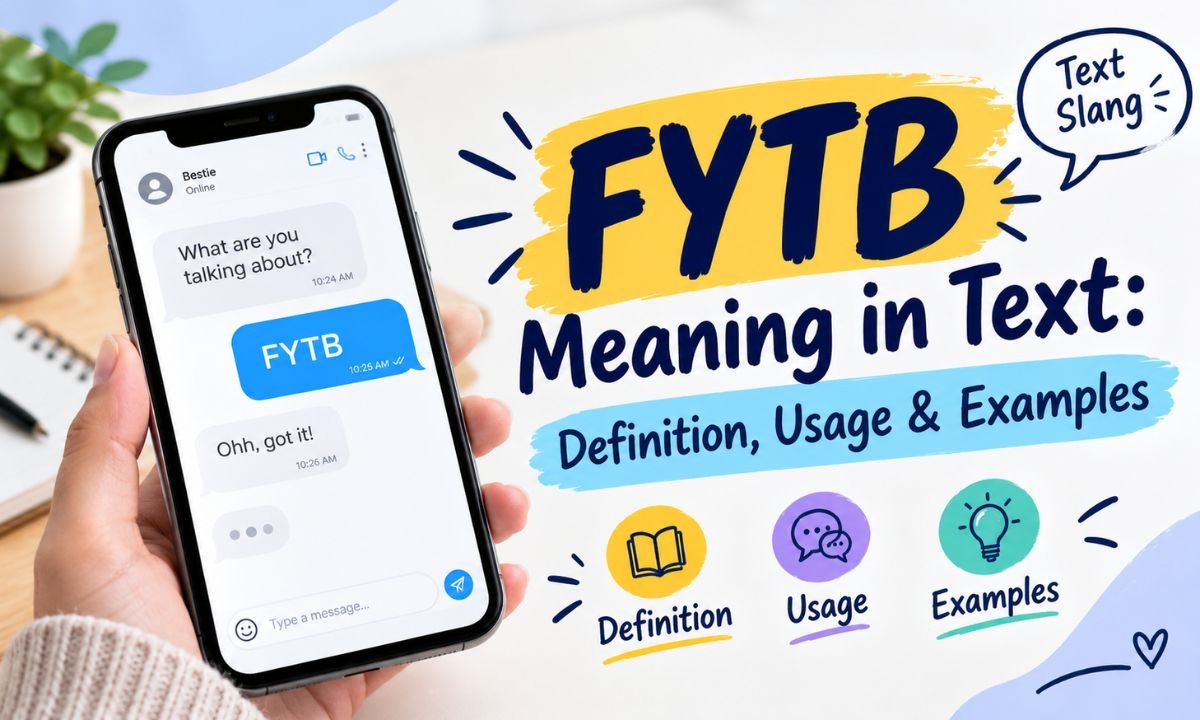

You open a chat and a friend replies with just “FYTB.” No context. Is it a joke, or are they annoyed?
Short answers like this are easy to misread, so let’s clear it up. This guide explains the FYTB meaning in text, how people use it on different apps, and when it’s better to avoid it. It is based on a review of current dictionary entries and slang guides.
What Does FYTB Mean in Text?
FYTB stands for “f* you talking ‘bout?”** In clean terms, it means “What are you talking about?”
People send it when something sounds confusing, unbelievable, or just wrong. It is internet slang, and it contains profanity, so tone matters a lot.
Read More: Tea Slang Meaning: What Does Tea Mean in Text and on Social Media?
Quick Facts:
- Full form: F*** you talking ‘bout?
- Clean meaning: What are you talking about?
- Type: Texting abbreviation / internet slang
- Tone: Blunt, teasing, or annoyed, depending on context
- Used on: Text messages, TikTok, Instagram, Snapchat
What Does FYTB Stand For?
Each letter has a job:
| Letter | Stands for |
|---|---|
| F | F*** (the profane word) |
| Y | You |
| T | Talking |
| B | ‘Bout (about) |
The phrase comes from casual spoken English, where “about” is shortened to “‘bout.” Online, people compressed the whole sentence into four letters.
One site lists a rarer reading, “f*** you too, b****,” used as an angry comeback. This is far less common. If you see FYTB in a confusing or heated moment, it’s worth checking which one the person meant.
How Is FYTB Used in Texting?
People rarely ask a real question with FYTB. It works more like a reaction, the way you’d raise an eyebrow in person.
Common uses:
- Disbelief: Someone makes a wild claim, and you can’t believe it.
- Confusion: You genuinely don’t understand the message.
- Pushback: You disagree and want to say so quickly.
- Playful teasing: You’re joking with a friend.
Punctuation and emojis change the feeling a lot:
- “FYTB 😂” reads as joking.
- “FYTB???” reads as shocked or confused.
- “FYTB.” with a period often reads as cold or serious.
FYTB Meaning in Chat and Social Media
The core meaning stays the same everywhere. What changes is how heavy it sounds.
| Platform | Typical use | Usual tone |
|---|---|---|
| Text messages | Reacting to a claim or excuse | Teasing or blunt |
| TikTok comments | Questioning a video or opinion | Playful, sometimes sarcastic |
| Instagram DMs and comments | Reacting to a story or caption | Casual |
| Snapchat | Quick replies to friends | Informal, fast |
| Group chats | Calling out an exaggeration | Funny, friendly |
Younger users tend to use it most. Among close friends it usually carries humor. Among people who barely know each other, it can come across as rude.
Examples of FYTB in Conversations
Here are realistic examples that show how tone shifts the meaning.
Example 1: Playful disbelief
Sam: I woke up at 5 a.m. and ran 10 miles.
Jay: FYTB 😂 you hit snooze four times yesterday.
Example 2: Real confusion
Ali: The meeting moved to Friday.
Noor: FYTB? Nobody told me.
Example 3: Pushback during a disagreement
Mia: You never told me you’d be late.
Leo: FYTB, I texted you an hour ago.
Example 4: Social media
A comment under a video: “Pineapple on pizza is the best.” Reply: “FYTB 💀”
Notice that Example 3 feels sharper than Example 1 even though the abbreviation is identical. The difference is the situation, not the letters.
Is FYTB Rude or Offensive?
It can be. The phrase behind it is profane, so FYTB is not polite language.
Whether it offends depends on three things:
- Relationship: Fine between close friends, risky with strangers.
- Setting: Not suitable for work emails, school chats, or family threads.
- Tone: A laughing emoji softens it. A flat “FYTB.” can feel aggressive.
Simple rule: if you wouldn’t say the full phrase to the person’s face, don’t send the abbreviation either.
For professional or formal chats, use “What do you mean?” or “Could you clarify?” instead.
How to Reply When Someone Says FYTB
Your reply depends on what they meant. Read the emojis and the situation first.
| If they seem… | Try replying with… |
|---|---|
| Joking | “Haha I’m serious though 😄” |
| Confused | “Sorry, let me explain. I meant…” |
| Annoyed | “I think there’s a mix-up. Can we sort it out?” |
| Disbelieving | “No joke, I can show you.” |
Tips for a good reply:
- Don’t match anger with anger.
- Clarify your original message in one or two sentences.
- If you’re unsure of their tone, just ask: “Are you joking or upset?”
FYTB vs. Similar Texting Abbreviations
FYTB is often mixed up with other short phrases. Here is how they differ.
| Abbreviation | Meaning | Tone | Best for |
|---|---|---|---|
| FYTB | F*** you talking ‘bout? | Blunt, challenging | Close friends |
| WYM | What you mean? | Neutral, curious | General chats |
| WDYM | What do you mean? | Neutral | Almost any chat |
| WTF | What the f***? | Shocked, strong | Reacting to surprise |
| IDK | I don’t know | Neutral | Any casual chat |
The key difference: WYM and WDYM ask for an explanation. FYTB challenges the statement. WTF shows shock, while FYTB questions what was actually said.
Frequently Asked Questions
What does FYTB mean in text?
It means “f*** you talking ‘bout?”, a slangy way of saying “What are you talking about?”
Is FYTB a bad word?
The abbreviation itself isn’t a word, but it stands for a profane phrase, so it’s best kept to casual chats.
Does FYTB always mean someone is angry?
No. Among friends it is often used for teasing or playful disbelief.
Can I use FYTB at work?
It’s better not to. Use “Could you clarify?” in professional settings.
Is FYTB the same as WTF?
Not quite. FYTB challenges a statement, while WTF expresses shock or surprise.
Where did FYTB come from?
It grew out of spoken slang and was shortened by texters and social media users who wanted faster replies. There is no single recorded origin.
Final Thoughts
FYTB is short, blunt slang for “What are you talking about?” Its meaning is simple, but its tone is not. Emojis, punctuation, and your relationship with the person all change how it lands.
When you see it, check the context before reacting. When you’re about to send it, think about who will read it. If there’s any doubt, the clean version, “What do you mean?”, will never get you in trouble.
